
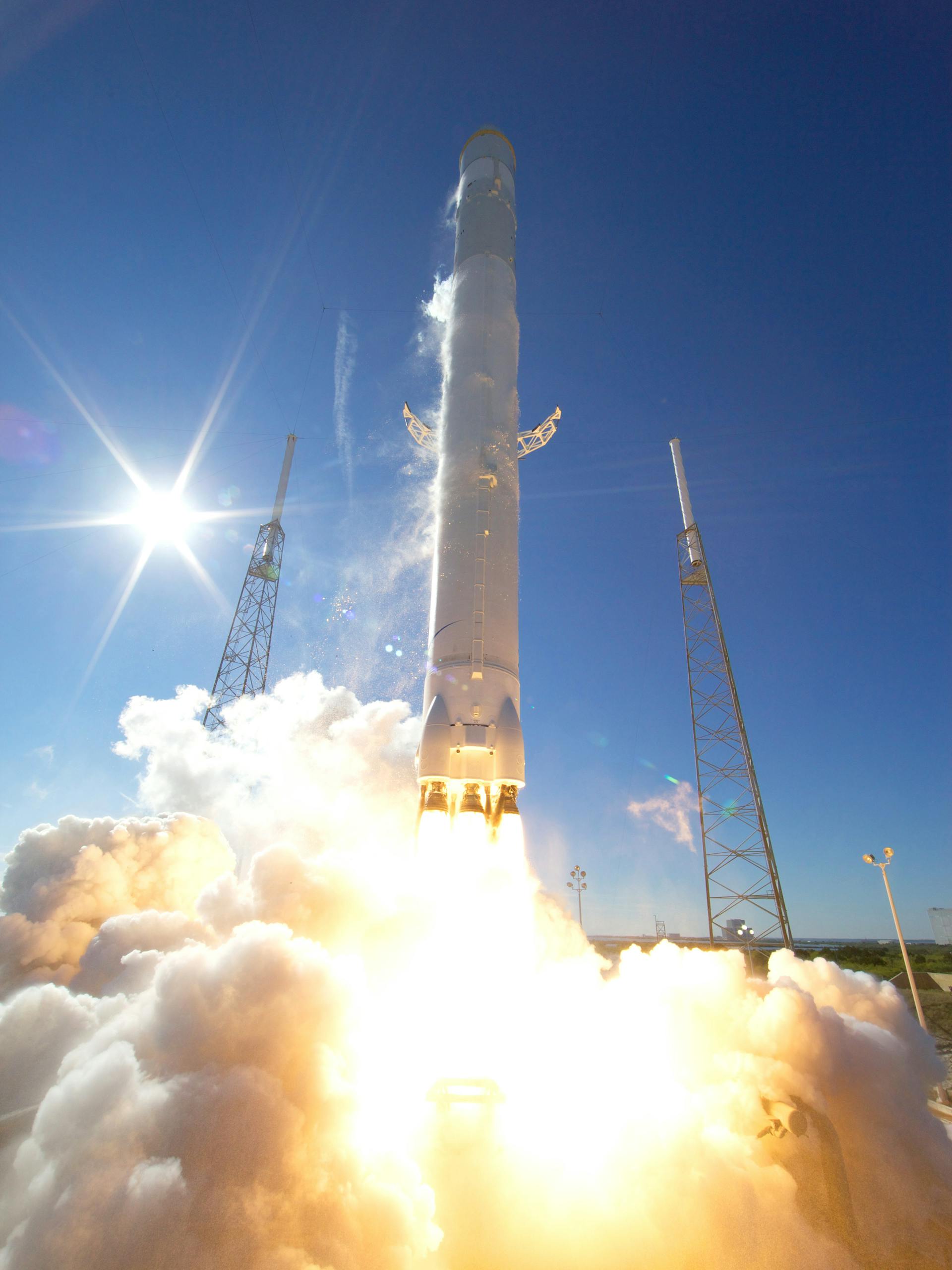
Rocket propellant chemistry has evolved from medieval gunpowder mixtures to modern high-performance fuels. Early rockets used simple black powder (charcoal, sulfur, and potassium nitrate) in bamboo tubes, but today’s launch vehicles rely on advanced liquid and solid propellants and even emerging green and electric options. Solid rockets typically use composite propellants (e.g. ammonium perchlorate – HTPB – Aluminum), while liquid rockets use bipropellants (e.g. RP‑1/LOX, LH₂/LOX) or storable hypergolic pairs (e.g. UDMH/N₂O₄). Monopropellants (e.g. hydrazine or concentrated H₂O₂) decompose over catalysts to produce thrust. Each class has distinct energy density, specific impulse (I_sp), combustion products, and stability considerations (see Chemistry and Performance). In modern systems, vanadium pentoxide (V₂O₅) appears as a catalyst (e.g. for H₂O₂ decomposition or as a burn-rate additive), a trace contaminant, and in high-temperature catalyst contexts (V₂O₅/TiO₂ catalysts for NOₓ removal).
Manufacturing of these propellants involves specialized processes: AP production (often via electrolytic methods), polymer binder curing, safe handling of toxic fuels (hydrazine, UDMH), and cryogenic storage (LOX, LH₂). Environmental and safety issues are paramount: solid rockets release HCl and Al₂O₃ particulates and long-lived perchlorate residues, while storable liquids pose toxicity hazards. Regulations (e.g. EPA perchlorate limits) and industrial practices (ITAR, military specifications) tightly control propellant use.
Modern trends include “green” monopropellants (e.g. hydroxylammonium nitrate – HAN and ADN-based fuels) with higher I_sp and lower toxicity, additive manufacturing of rocket fuel grains, and integration with advanced in-space propulsion (e.g. electric thrusters, though these require distinct propellants like xenon). We compare propellant classes qualitatively on performance (I_sp), density, cost, and safety, noting trade-offs: cryogenic H₂/LOX offers the highest I_sp (~450 s) but demands complex tanks, while solids offer storability and thrust at the cost of emissions.
Outlook: Ongoing research aims to close gaps in green propellant chemistry, improve safe manufacturing (e.g. new catalysts, 3D-printed grains), and enhance sustainability (cleaner combustion, recyclable materials). High‐energy density materials and lower-toxicity oxidizers are active fields, as is the integration of chemical rockets with electric/solar propulsion in hybrid mission profiles. Remaining challenges include controlling combustion instability, developing higher-performance yet safe fuels, and minimizing environmental impact while meeting rigorous space mission requirements.
Historical Development of Rocket Propellants
The history of rocket propellants parallels the history of rocketry itself. The earliest rockets (Song Dynasty China, 10th–13th centuries) were essentially gunpowder-filled tubes. Gunpowder – a mixture of ~15% charcoal (C), 10% sulfur (S), and 75% potassium nitrate (KNO₃) – produced gas and heat to propel “fire-arrows” in warfare. These simple solid-propellant rockets (on sticks for stability) spread to Europe and India by the 17th–18th centuries (e.g. Congreve rockets), but were eventually supplanted by more predictable gunpowders and then smokeless powders.
In the late 19th–early 20th century, scientific rocketry emerged. Tsiolkovsky (1903) theorized liquid propellant rockets, and Goddard launched the first liquid-fueled rocket in 1926. Early liquid-fuel rockets used alcohol (ethanol)/LOX or ethyl alcohol/LOX, reaching modest I_sp (~200–250 s). During WWII the German V-2 rocket (1944) used 75% ethanol/LOX (with dissolved water), setting a performance benchmark (I_sp ≈ 250 s) for liquids.
After WWII, both military missiles and space launchers spurred new propellant development. The Soviet R-7 (1957, Sputnik) and the US Atlas missile used Kerosene (RP‑1)/LOX (I_sp ≈ 300–350 s). U.S. and USSR ballistic missiles also fielded storable hypergolics: e.g. Aerozine-50 (50/50 UDMH/hydrazine) with N₂O₄ (nitrogen tetroxide) as oxidizer. These mixtures were toxic but launch-ready at any time, crucial during the early Space Race. In contrast, the Saturn V (1960s) used LH₂/LOX (I_sp ~ 450 s) for high performance, at the cost of complex cryogenic systems.
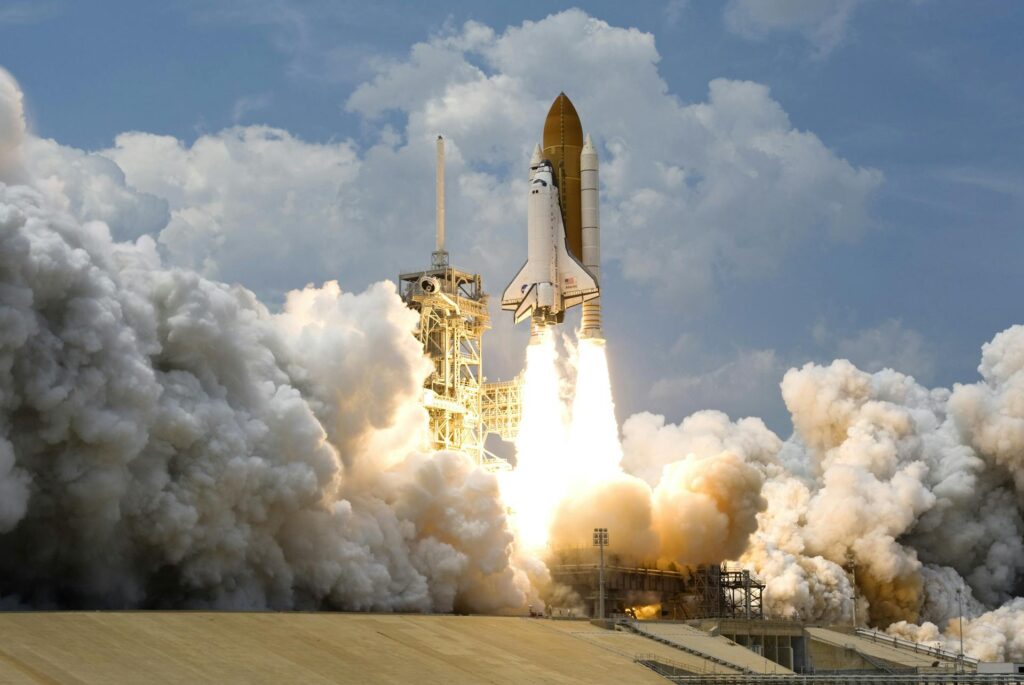
Solid rockets advanced in parallel. The US Polaris and Minuteman ICBMs (1960s) used composite solid propellants (ammonium perchlorate (AP) oxidizer, polymer binder, aluminum fuel). A landmark was the Space Shuttle Solid Rocket Boosters (1981–2011), with AP/HTPB/Al propellant ~68/18/14 by mass. Hybrids (solid fuel plus liquid oxidizer) appeared in the 2000s (e.g. SpaceShipOne using HTPB and nitrous oxide). Today, new boosters (e.g. SpaceX Super Heavy) use liquid methane/LOX hybrids, blending liquid performance with reuse.
Classes of Rocket Propellants
Solid Propellants
Black powder was humanity’s first propellant. Later, double-base propellants (nitrocellulose plus nitroglycerin) appeared in the late 19th century. These are homogeneous solids where fuel and oxidizer are chemically bound (nitrocellulose (a nitrated polymer) and nitroglycerin both supply O₂ and fuel internally). Double-base powders were used in small rockets and artillery, but safety (sensitivity to shock/temperature) limited large-scale use.
Modern large solid motors use composite propellants: a mechanically mixed blend of distinct oxidizer and fuel particles. The most common formulation is APCP (ammonium perchlorate composite propellant). A typical APCP consists of ~70–85% AP (NH₄ClO₄) oxidizer, ~10–20% polymer binder (fuel) and ~5–20% metal fuel (usually aluminum). For example, Shuttle SRB propellant was roughly 68% AP, 18% Al, and 14% HTPB binder. AP decomposes to release oxygen, which then combusts the binder and Al. Additives (e.g. iron oxide, ferrocene) act as burn-rate catalysts. Such solids deflagrate (burn) from the surface inward, with burn rate increasing with chamber pressure (St. Robert’s law, r ∝ Pⁿ). Typical I_sp for AP/HTPB/Al is ~250–300 s (sea-level equivalent) and moderate density, making them energy-dense and stable when cast. Other solids include AN-based propellants (ammonium nitrate instead of perchlorate, for “low-smoke” or green reasons) and HTPB/RFNA hybrid rockets (solid binder plus red fuming nitric acid oxidizer) in some cases.
Liquid Propellants
Bipropellant systems carry separate fuel and oxidizer liquids. Cryogenic biprops like LH₂ (H₂)/LOX and RP‑1 (kerosene)/LOX dominate high-performance launchers. LH₂/LOX yields very high I_sp (~430–450 s in vacuum) due to hydrogen’s low molecular weight, but requires massive cryotanks. RP-1/LOX (used by Falcon 9, Soyuz) gives I_sp ~300–350 s, is denser and easier to handle but yields CO₂ and soot.
Storable biprops use liquids that remain ambient liquids. Common fuels include UDMH (C₂H₈N₂) or monomethylhydrazine (MMH), paired with N₂O₄ oxidizer. These mixtures hypergolically ignite (auto-ignite on contact) and have I_sp ≈ 300–330 s. Example reactions: UDMH + N₂O₄ → N₂ + H₂O + CO₂ + HCl (approximately). Hydrazine (N₂H₄) itself can be a monopropellant but also serves in biprops. Spacecraft attitude thrusters and orbital maneuvering systems have long used MMH/N₂O₄ or N₂H₄/N₂O₄ for storability, despite toxicity.
Monopropellants
A monopropellant decomposes on a catalyst or heat alone. Classic is hydrazine (N₂H₄) which decomposes to N₂, H₂, NH₃ (and H₂O if oxygen present) over a catalyst, yielding I_sp ~220–240 s. High-concentration hydrogen peroxide (HTP) (70–98% H₂O₂) is another monopropellant. Passing H₂O₂ over a catalyst (commonly silver or platinum, or V₂O₅) yields steam and O₂. V₂O₅-based catalysts activate (decompose) hydroperoxides effectively. HTP provides a “green” monopropellant (products are just steam/oxygen) with moderate I_sp (~150–180 s as monopropellant, up to ~250–300 s if used as strong oxidizer). New green monoprops include hydroxylammonium nitrate (HAN) blends (e.g. Aerojet’s AF-M315E) and ammonium dinitramide (ADN) fuels (ESA’s LMP-103S). These ionic liquids offer higher density and I_sp (~260–300 s) and much lower toxicity than hydrazine.
Hybrid Propellants
Hybrids combine features of solids and liquids. Typically a solid fuel grain (often HTPB or paraffin-based polymer) and a liquid oxidizer (e.g. nitrous oxide or H₂O₂). They are safer to store than bipropellants (non-self-pressurizing, non-hypergolic) and simpler than liquid engines. Virgin Galactic’s SpaceShipTwo used HTPB/rubber and nitrous oxide (nitrous oxide yields moderate I_sp ~200–250 s with HTPB). Hybrids can even incorporate solid oxidizers (AN or AP) in the fuel for higher energy. Additives (e.g. metal powders) can boost energy but complicate grain casting.
Electric Propulsion (for Comparison)
Although not chemical, electric thrusters (ion, Hall, plasma) are increasingly important. They use inert propellants (xenon, krypton) and electricity to produce thrust with very high I_sp (1500–4000 s) at low thrust. Chemical rockets still provide rapid high thrust for launch, while electric systems complement them in space. As a side note, “chemical” propellant discussions inform propellant storage and handling even for electric: xenon storage is high-pressure gas, and safety/environment standards apply.
Chemical Reactions, Energy & Performance
Rocket fuels rely on exothermic redox reactions. In solids, an oxidizer (like AP) first decomposes (e.g. NH₄ClO₄ → N₂ + HCl + O₂ + …) and then the liberated oxygen reacts with binder hydrocarbons and metal fuels: for AP/Al/HTPB, products include Al₂O₃ (alumina smoke), HCl, H₂O, CO₂, and N₂. Liquid propellant combustion in the chamber produces mainly gaseous products: kerosene/LOX yields CO₂ and H₂O; LH₂/LOX yields H₂O; hydrazine/NTO yields N₂, H₂O, and some NOₓ. Monopropellants decompose: H₂O₂ → H₂O + ½O₂; N₂H₄ → N₂ + H₂ (with heat).
A key metric is specific impulse (I_sp), thrust per propellant weight flow. Higher I_sp means more efficient propellant. For example, LOX/LH₂ achieves ~450 s in vacuum (the theoretical limit ~470 s) while RP‑1/LOX is ~350 s. Hydrazine monoprop gives ~230 s. Solid AP/HTPB/Al motors achieve roughly 250–300 s (depending on pressure). Hypergolic UDMH/N₂O₄ combos reach ~300–330 s. Liquid propellants also have density specific impulse (I_sp×density) – e.g. RP-1 has higher volumetric density than LH₂, meaning more thrust per unit tank volume even if I_sp is lower.
Higher heat of combustion (MJ/kg) and lighter exhaust gases (low average molecular weight) raise I_sp. Liquid engines mix fuel/oxidizer intimately allowing near-complete combustion, while solids burn from the surface with complex heat transfer. Burn rate in solids increases with pressure (r ∝ Pⁿ). Catalysts and additives (e.g. ferrocene, V₂O₅) can raise burn rates in solids, but can also affect stability.
Vanadium Pentoxide (V₂O₅) in Propulsion
Catalyst: Vanadium pentoxide (V₂O₅) is a strong oxidizing agent and a common catalyst in propellant chemistry. Notably, vanadium(V) compounds catalyze decomposition of hydroperoxides. In advanced monopropellant thrusters using hydrogen peroxide or HAN-based fuels, V₂O₅ or related vanadates can serve as the catalyst bed material. For example, silver catalysts are often used for H₂O₂, but vanadia catalysts (V₂O₅ supported on alumina or silica) also decompose peroxide effectively. In solid propellants, finely dispersed V₂O₅ has been studied as a burn rate additive. The cited literature notes that vanadium pentoxide can “provide additional oxygen” and increase the burn rate of oxidizer-rich propellants, by cycling between oxidation states and releasing O₂ radicals. Thus, small fractions of V₂O₅ or other vanadium oxides have been tested to enhance composite propellant performance.
Contaminant: Vanadium could appear as an impurity (e.g. from alloy additives in engine components) and potentially poison or alter catalysts. High temperatures in combustion might convert trace vanadium to V₂O₅, but this is a minor effect. More often, one worries about alkali salts (K, Na) in AP and heavy metal traces. Vanadium compounds are not typical propellant contaminants in significant amounts.
High‐Temperature Material: V₂O₅ itself is not a structural material (melting point ~690 °C) and would liquefy in a rocket chamber. However, vanadium metal alloys (V–Ti–Al) are used in airframe materials for high temperatures. V₂O₅ surfaces could be used in sensors or coatings for high-temp uses, but these are specialized niche roles.
Aftertreatment/Catalysis: On Earth, V₂O₅/TiO₂ catalysts are widely used in SCR (selective catalytic reduction) to remove NOₓ from engine and power-plant exhaust (via NH₃+NOₓ → N₂+H₂O). Rocket engines aren’t fitted with exhaust aftertreatment, but the concept is related: vanadia catalysts oxidize pollutants. In rocket tests, V₂O₅ has been used in gas generators or post-combustion units to clean up residual H₂O₂ or unburned fuel. Research on regenerating vanadium from spent sulfuric acid plants also highlights V₂O₅’s robustness. In summary, V₂O₅ serves mainly as a catalyst in propellant contexts, rather than as a propellant component.
Key Propellant Chemicals and Functions
We summarize major chemicals (formulas in parentheses), roles, and typical use:
- Ammonium Perchlorate (NH₄ClO₄) – Solid oxidizer (AP). Used in composite solids with binder and Al. Decomposes to release O₂, and forms HCl, N₂ as byproducts.
- Hydroxyl-Terminated Polybutadiene (HTPB) – A rubbery binder (fuel) for composite solids. Cross-links to solidify. Provides long-chain hydrocarbons (C, H) to burn with AP.
- Aluminum Powder (Al) – Energetic fuel additive in solids. High heat and yields Al₂O₃ particles, raising flame temperature and I_sp (but adds weight of exhaust particles).
- Hydrazine (N₂H₄) and MMH/UDMH (CH₃NHNH₂) – Toxic liquid fuels. Hydrazine is a monopropellant (catalytic decomposition) and bipropellant fuel; UDMH (unsym. dimethylhydrazine) or MMH are hypergolic fuels. React with oxidizers like N₂O₄ or IRFNA (inhibited HNO₃).
- Nitrogen Tetroxide (N₂O₄) – Liquid oxidizer. Hypergolic with hydrazine fuels. Equilibrium with NO₂ gas. Common in spacecraft.
- Triethylaluminum (TEA, C₆H₁₅Al) and Triethylborane (TEB, C₆H₁₅B) – Hypergolic ignition fluids used (e.g. in Titan rockets) to ignite tough mixtures. Ignites spontaneously with air or oxygen.
- RP-1 (C₁₂H₂₆) – Highly refined kerosene. High density hydrocarbon fuel for LOX. Used in Falcon, Atlas, Soyuz, etc.
- Liquid Oxygen (O₂) – Oxidizer, cryogenic. Supports combustion of all hydrogen and hydrocarbon fuels. Very high I_sp in combination with LH₂, CH₄, or C₁₂H₂₆.
- Liquid Hydrogen (H₂) – Fuel, cryogenic. Highest specific energy (MJ/kg) of any propellant. Coolant bleed often needed.
- Nitrocellulose (C₆H₇N₃O₁₁) – Nitrated cellulose. Primary ingredient in single-base (NC only) or double-base propellants. Provides both fuel and oxidizer.
- Nitroglycerin (C₃H₅N₃O₉) – Liquid nitrate ester fuel/oxidizer. Mixed with NC in double-base powders.
- Hydroxylammonium Nitrate (HAN, NH₃OHNO₃) – Key ionic component of green monopropellants (e.g. AF-M315E). Offers high density and better I_sp than hydrazine.
- Ammonium Dinitramide (ADN, NH₄N(NO₂)₂) – Oxidizer in LMP-103S (Sweden’s green monopropellant). Improves performance over hydrazine and less toxic.
- Perchlorates and Nitrates – Inorganic oxidizers (e.g. ammonium perchlorate, ammonium nitrate) in solids and hybrids. Provide oxygen on decomposition.
- Metal oxides (Fe₂O₃, CuO) – Burn rate catalysts in solids.
- Solvents and Plasticizers – E.g. acetone (for NC), DOA (dioctyl adipate, plasticizer), etc., used in manufacturing to achieve desired viscosity, burn rate, or safety. Often mixed in binder systems.
- Stabilizers – Diphenylamine, IRFNA inhibitors, etc., added to propellants to prevent decomposition during storage.
- Metal additives – Boron (B), Magnesium (Mg), etc., used in some specialty propellants for high energy or ignition, though aluminum is most common.
These chemicals are combined carefully. For example, Space Shuttle SRB propellant was nominally 68% NH₄ClO₄, 18% Al, 14% HTPB, plus ~2% iron oxide catalyst. In contrast, a hypergolic engine fuel tank might contain 100% MMH with an auxiliary catalyst unit (Ir or Pt coated) for ignition.
Manufacturing, Purification, and Safety
Manufacturing: Producing rocket propellants requires strict chemical processes. For solids, AP crystals are grown electrolytically or by oxidation of NH₄Cl; particle size is controlled (30–400 μm). The binder (HTPB) is synthesized by polymerization and mixed with oxidizer powder, metal, and catalysts. Mixing is often done under vacuum or low shear to minimize voids, then cast and cured (crosslinked with diisocyanate). Double-base powders involve nitrating cotton and glycerol (Raschig process for nitroglycerin). Liquid fuels like hydrazine are industrially produced by the Raschig–Butler process from NH₃, and nitric acid production for N₂O₄ yields red fuming nitric acid (RFNA) which is then cleaned.
Purification: Rocket propellants demand high purity. Impurities can destabilize (e.g. Cl–, Cu++, heavy metals can catalyze decomposition). H₂O₂ must be distilled to >90% and stabilized with inorganic buffers. LOX/LH₂ come from fractional distillation of air (requiring complex refrigeration). RP‑1 is a highly refined kerosene (similar to jet fuel but with tight controls on sulfur and aromatics). Ammonium perchlorate is purified by dissolution and recrystallization to remove ions.
Storage and Handling: Propellant storage spans from ambient tanks to cryogenic silos. Storable liquids like UDMH, MMH, and N₂O₄ are kept in stainless steel tanks with corrosion-resistant seals; they are highly toxic, carcinogenic, and require remote handling. IRFNA must be inhibited with HF or HNO₂ to prevent fuming. LH₂ and LOX require cryogenic dewars and loss boil-off. Solids, once cured, are stable (AP/HTPB is Class 1.3 per UN – moderate fire hazard, but low volatility). However, aluminum powder is pyrophoric and explosive when airborne, so composite propellants demand rigorous dust control.
Safety Practices: There are exhaustive regulations (OSHA, EPA, ATF) governing propellant manufacture. Plants often have inerting systems, blast walls, and remote mixing. NASA and defense contractors follow strict material-handling protocols. For example, hydrazine and perchlorate are regulated under environmental laws (REACH in Europe, EPA in US) due to toxicity. Emergency teams train for spills, and disposal of unused fuel must neutralize chemicals (e.g. alkaline permanganate washes for hydrazine).
Environmental Impacts: Many propellants have environmental downsides. AP solids produce HCl and chlorinated particulates; around 30% of AP mass becomes HCl. This gas is corrosive and acidic, prompting launch site water deluge systems to neutralize it. Unburned Al forms alumina dust (Al₂O₃), a respiratory hazard. Perchlorate (ClO₄⁻) is water-soluble and toxic (it disrupts thyroid function); EPA standards now target <20 ppb in drinking water because of rocket fuel and fireworks residues. Hydrazine and UDMH are carcinogenic; satellite propulsion systems now seek replacements. LOX/LH₂ combustion is very clean (only water vapor), but methane/LOX and RP-1/LOX produce CO₂ and H₂O. N₂O₄-hydrazine engines emit NOₓ and sometimes light hydrazine decomposition products. Modern launch authorities monitor contamination: NASA studies documented >9 ppm HCl near a pad after shuttle launches.
Manufacturing also carries hazards: nitrations for NC or NG produce toxic fumes; AP dust is flammable/explosive. Facilities mitigate this with inert atmosphere bladders or nitrogen blankets. Regulatory practices include permissible exposure limits (e.g. 5 ppm HCl) and full protective gear when handling hydrazine. Industry is moving toward “green” propellants (see below) and cleaner composite formulas (e.g. replacing aluminum with magnesium or removing perchlorate) to reduce environmental footprint.
Modern Trends and Future Outlook
Green Propellants: A prime trend is replacing toxic fuels. NASA’s GPIM project demonstrated AF-M315E, a HAN-based monopropellant, in orbit. AF-M315E has ~50% higher density-specific impulse than hydrazine and is much less toxic. Similarly, the Swedish Space Corporation flew LMP-103S (ADN-based) on small satellites. These “ionic” fuels combust to N₂, H₂O, and minor N₂O, avoiding hydrazine’s ammonia/arsine byproducts. Hydrogen peroxide is revisited too: small spacecraft thrusters now use 90% H₂O₂ for attitude control (catalyst beds of silver or alumina). Even solid propellant formulations are “greened” by substituting ammonium nitrate for perchlorate and fine-tuning metal loads to cut smoke and HCl.
Additive Manufacturing: 3D printing is revolutionizing propellant manufacturing. Direct-print systems can fabricate solid motor grains with complex internal geometries for tailored burn profiles. For example, researchers have printed AP/HTPB composite strands at 85% solids, achieving burn rates similar to conventionally cast grains. This promises rapid prototyping of motors, spatially graded propellant (e.g. higher burn-rate patches), and safer dry manufacturing (less manual casting). On the engine side, companies (SpaceX, etc.) already 3D-print injector plates and chambers, enabling new combustion cycles and materials that tolerate higher temperatures and pressures.
In-Space Propulsion: While not chemical, advanced in-space systems affect chemical propellant use. Electric thrusters (ion and Hall) use xenon or krypton, but they often rely on small hydrazine/RCS thrusters for initial maneuvers. Some future concepts blend chemical and electric: e.g. chemical boost to orbit and then high-I_sp electric cruise. Additionally, resistojets and green monoprop thrusters (Hall-derived) aim to bridge mid-tier performance. Research in nuclear thermal rockets (using H₂ or ammonia heated by reactor) looks at maximizing chemical propellant energy density. High-density hydrogen carriers (slush hydrogen, metal hydrides) have been explored to improve LH₂ systems.
Comparative Trade-Offs: Qualitatively, chemical propellant choices balance performance, cost, safety, and footprint. Cryogenic propellants (LH₂/LOX) excel in I_sp (~450 s) but incur high development costs (insulation, boil-off losses) and complexity. Dense storable fuels (RP-1/LOX or hypergolics) pack more mass into a given volume and allow rapid reuse (no pre-cooling), but their toxicity and lower I_sp (~300–330 s) are trade-offs. Solid rockets have highest thrust-to-weight and storability (no pumps or cryo) but cannot be throttled or shut down, and they pollute the atmosphere. Hybrids sit in-between – safer to store than biprops and controllable thrust – but typically yield lower I_sp (~250 s) unless exotic additives are used. Monopropellants like hydrazine are simple but very low I_sp (~220 s) and highly toxic; green monoprops raise I_sp toward 250–300 s with lower toxicity. In summary: Performance (I_sp) ranks LH₂/LOX highest > hydrocarbon/LOX ≈ N₂O₄/hydrazine > solids > hydrazine. Safety/handling ranks LH₂/LOX (non-toxic oxidizer, but cryo hazards) > solids (inert until lit) > H₂O₂ (hazardous concentration) > storable hypergolics (worst toxicity). Cost follows mission scale: large cryogenic stages justify infrastructure, while small launch or tactical rockets favor storable or solid propellants for simplicity.
Regulatory Landscape: Agencies are increasingly limiting hazardous fuels. EPA and NASA policies now favor HTP and green fuels over hydrazine. The FAA and launch providers impose strict safety reviews for propellant use. Environmental regulations (like perchlorate MCLs) may eventually constrain solid rocket launches near populated water sources. Internationally, programs like ESA’s ARENA initiative push ADN/HAN propellants for eco-friendly spacecraft.
Conclusion and Outlook
Rocket propellant chemistry remains an active field. Future rockets may use novel oxidizers (e.g. fluorine derivatives for ultra-high I_sp, though extremely toxic) or exotic metal fuels (boranes were once tested for high energy). Efforts continue in catalyst and additive research: V₂O₅ and related substances will be studied to improve burn rates or detoxify exhaust. Materials science will yield new binders or liners that tolerate hotter combustion or simplify manufacturing. 3D printing is likely to transform both engines and fuels, enabling designs impossible by casting or machining alone.
Open research gaps include finding truly clean, high-performance propellants (e.g. liquid oxygen + liquid methane is a stepping-stone, but alternatives like methane/hydrogen blends, or LOX + liquid ammonia, are explored). Improving stability and safety is ongoing: solid fuels with “self-healing” binders or liquids with non-toxic ignition will reduce risk. The interplay with electric propulsion suggests hybrid mission architectures where chemical rockets give a high-thrust launch or capture, then ion drives cruise, demanding integrated propulsion planning.
In summary, the chemistry of rocket propellants is a mature yet evolving science. From charcoal-powered arrows to 3D-printed composite grains, each innovation in propellant chemistry unlocks new capabilities. Key challenges remain in reconciling performance with safety and sustainability. Continued research – much of it published by NASA, ESA, and academic propulsion laboratories – will guide the next generation of launch and space propulsion systems.
Sources: Authoritative texts and reports (NASA Glenn tutorials, Encyclopedia of Energy), NASA/ESA technical papers, and recent space technology publications were used to ensure accuracy. These sources detail propellant chemistry, history, and cutting-edge developments as cited.